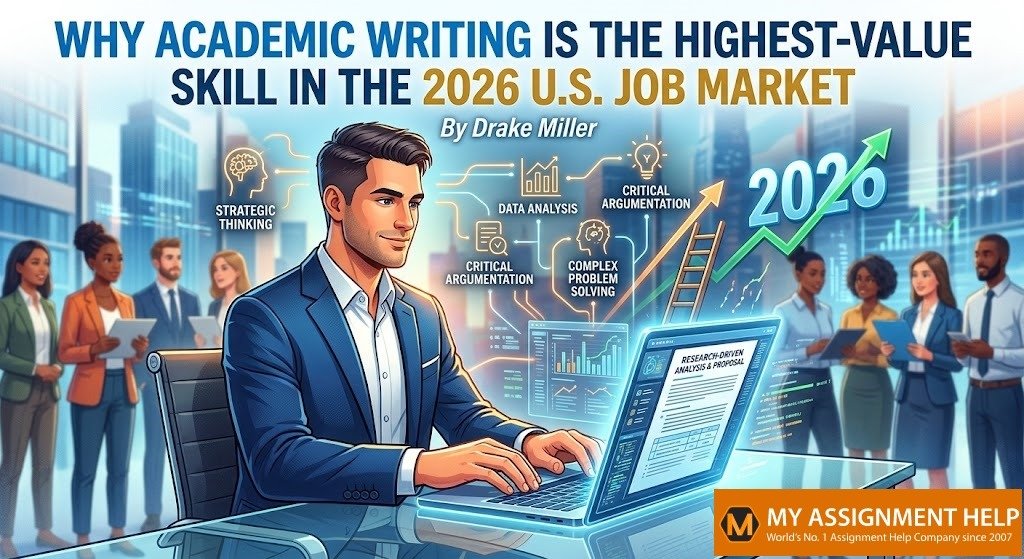
In an era dominated by rapid-fire Slack messages, AI-generated drafts, and instantaneous digital updates, the value of traditional academic writing is often questioned by those entering the workforce. High school and college students frequently ask, “When will I ever need to write a 2,000-word argumentative essay in the real world?”
The answer is: every single day.
While the format of your writing changes once you move from the classroom to the corporate office, the core mechanics of academic writing—critical thinking, structural logic, evidence-based persuasion, and syntactical precision—remain the “gold standard” for professional success. In the hyper-competitive American job market of 2026, these skills aren’t just academic requirements; they are high-value economic assets and essential transferable skills.
The Macro View: The Knowledge Economy and the “Written Word”
The modern American workforce is increasingly a “knowledge economy,” where the primary commodity is information. According to recent data from the National Association of Colleges and Employers (NACE), over 73% of employers identify strong written communication as one of the most desired attributes on a candidate’s resume. It consistently outranks many technical “hard skills” in terms of long-term career durability and leadership potential.
Whether you are entering healthcare, tech, finance, or the creative arts, your ability to document your thoughts clearly determines your professional trajectory. In the U.S., where remote and hybrid work models have become the standard for Fortune 500 companies, the “written word” has effectively replaced the “watercooler talk.”
See also: Women in Crypto Industry
The Visibility Gap
If you cannot communicate your value or your project’s status through a well-structured report or a persuasive email, you risk becoming invisible in the digital workspace. In 2026, professional visibility is no longer about who is loudest in the room; it is about who is clearest on the screen. Mastering academic writing ensures you can bridge this visibility gap by producing professional-grade documentation that commands attention from stakeholders and executives.
1. Critical Thinking and Information Synthesis
At its heart, academic writing is the process of taking complex information, analyzing it, and synthesizing it into a coherent argument. This is exactly what American employers call “high-level problem-solving.”
In high school and college, the rigors of essay writing teach you to:
- Evaluate the credibility of sources: In an age of digital misinformation, being able to vet a source for bias and accuracy is a top-tier professional skill. This is particularly vital when exploring complex anatomy research topics where scientific accuracy is the difference between a breakthrough and a mistake.
- Identify cognitive biases: Understanding the “why” behind a data point allows for better business intelligence and objective decision-making.
- Connect disparate data points: Forming a logical conclusion from a messy, unrelated dataset is the essence of strategic consulting and data science.
In the job market, this translates to market research, competitive analysis, and strategic planning. A marketing manager at a firm in New York or San Francisco needs to look at consumer data (the research) and write a proposal (the essay) on why a certain campaign will work. If the workload becomes overwhelming, many professionals and students utilize research proposal writing service at Myassignmenthelp.com to ensure their initial drafts meet the logical rigor required to win executive approval or secure a multi-million dollar budget.
2. The Power of Persuasion: Rhetoric in the Boardroom
Every “A” paper you’ve written was likely an exercise in rhetoric—the art of persuasion. In the American business landscape, persuasion is the engine of growth. Whether you are a startup founder pitching to venture capitalists in Silicon Valley or a non-profit coordinator writing a grant proposal in D.C., the mechanics of the “argumentative essay” are your primary tools.
Consider the “Case Study,” a staple of both MBA programs and B2B (business-to-business) marketing. A case study is essentially an academic essay in a professional suit. It presents a problem, provides evidence of a solution, and concludes with a definitive call to action. Students who master the ability to build a “thesis statement” and support it with empirical evidence are naturally better at:
- Pitching to investors with data-backed narratives rather than just “vibes.”
- Negotiating raises or contracts by documenting performance through evidence-based reporting.
- Leading teams toward a common goal through clear, inspiring mission statements and internal memos.
3. Structural Logic and “The Flow”
One of the biggest complaints from U.S. hiring managers is that new hires often struggle with structural clarity. In a fast-paced corporate environment, “fluff” is the enemy.
Academic writing teaches you the importance of an introduction, body paragraphs, and a conclusion. It teaches you how to use transition words to guide a reader through your logic. In a professional setting, this prevents “information overload.”
The Cost of Inefficiency
A well-structured memo saves a CEO time, and in the American market, time is the most expensive commodity. If a manager has to read your email three times to understand your main point, you have failed the “efficiency test” of the modern office. Mastering the “inverted pyramid” style of writing—putting the most important information first—is a direct byproduct of learning how to write effective thesis statements.
4. Agentic Literacy: The Impact of AI on Writing Skills
With the rise of generative AI tools, many argue that writing skills are becoming obsolete. On the contrary, AI has made human writing skills more valuable through what I call Agentic Literacy.
While AI can generate text, it often lacks “voice,” nuanced logic, and factual accuracy. The American job market now seeks “Editors-in-Chief” rather than just “Writers.” To use AI effectively, you must understand the mechanics of a good sentence and the logic of a strong argument to verify and polish what the machine produces.
The Internal Compass
If you don’t know how to write an essay from scratch, you won’t know how to prompt an AI to create a high-quality one. You won’t be able to spot the subtle hallucinations or logical fallacies that AI frequently introduces. Academic writing gives you the “internal compass” to know when an AI-generated draft is mediocre, biased, or misleading. In 2026, the highest-paid professionals are those who can direct AI with precision—a skill rooted in the fundamentals of rhetoric and composition.
5. The ROI of Writing: Economic Value of Academic Skills
Why does the American economy reward good writers? Because clear writing reduces “transactional friction.”
- Reduced Errors: Clear instructions lead to fewer mistakes in manufacturing, code development, and service delivery.
- Faster Decision Making: When proposals are logically sound and formatted for readability, executives can say “yes” faster.
- Global Collaboration: The U.S. is a melting pot of global business. Writing clearly is a matter of inclusivity. Academic writing emphasizes “clarity over fluff.” In a professional setting, being able to explain complex ideas in simple language ensures that team members from diverse backgrounds can collaborate effectively.
6. Attention to Detail and Professional Credibility
In academic writing, a misplaced comma or a poorly cited source can lower your grade. In the professional world, these “minor” errors can cost a company a client, a contract, or its reputation.
Grammar, punctuation, and formatting are the “dress code” of the digital world. If your professional correspondence is riddled with errors, it signals a lack of discipline and a lack of respect for the recipient. By mastering the meticulous nature of academic citations and APA/MLA styles, students develop a “quality control” mindset that is invaluable in high-stakes industries like law, engineering, and medicine.
7. Transitioning from Classroom to Career
For High School Students
At this stage, writing helps you navigate the college admissions process. Your “Personal Statement” is arguably the most important “guest blog” you will ever write. It requires extreme self-reflection and the ability to market your personal brand—skills that will later be used on LinkedIn and during job interviews. High school is where you build the muscle memory for career readiness.
For College Students and Beyond
In college, writing becomes more specialized. You move from general essays to technical reports, white papers, and research findings. This specialization mimics the “niche” expertise required in the American job market. Whether you are seeking academic support to refine your technique or working through a complex thesis, you are essentially engaging in “on-the-job training” for the high-level reports you will write as a professional leader.
8. How to Improve Your Writing for the 2026 Job Market
If you are a student looking to boost your employability, consider these steps:
- Read Beyond the Curriculum: Read Harvard Business Review, The Wall Street Journal, or industry-specific journals. Notice how they structure their arguments and use data to support claims.
- Practice Short-Form Logic: Try to summarize a 10-page research paper into a 3-paragraph executive summary. This mimics the brevity required in the C-suite.
- Audit Your Digital Tone: Treat every email to a professor as a trial run for an email to a boss. Avoid “text-speak” and focus on professional formatting.
- Use Professional Resources: Don’t be afraid to use writing labs or online platforms to help bridge the gap between your current skill level and the “Ivy League” standard expected by top-tier employers.
Frequently Asked Questions
Q.1 Is academic writing still relevant in an AI-driven workplace?
Yes. AI is a tool, not a replacement for logic. The U.S. job market values professionals with “Agentic Literacy”—those who can audit AI outputs for logical consistency and ethical soundness.
Q.2 What is the biggest difference between college and professional writing?
Concision. In college, you often meet word counts; in business, you meet deadlines by being brief. However, the requirement for evidence-based logic remains identical.
Q.3 Which soft skills does writing develop most?
Critical thinking, empathy (understanding the reader’s needs), and project management (organizing a large document from start to finish).
Q.4 How can I practice “American” professional tone?
Focus on “Plain English.” Avoid overly flowery language and prioritize clarity, directness, and the “Inverted Pyramid” structure.
Conclusion
The “American Dream” is often built on the ability to communicate a vision. From the Declaration of Independence to the latest tech white paper, the history of U.S. success is a history of effective writing.
For high school and college students, every essay you write is a brick in the foundation of your future career. When you master the ability to move a reader’s mind with your words, you become an indispensable asset. In the 2026 job market, the most successful individuals won’t just be those who can code—they will be those who can write the story of why their work matters.
For more insights on mastering the transition from academic life to professional success, or for assistance in refining your writing standards to meet American university requirements, explore the resources available at Myassignmenthelp.com.
About the Author – Drake Miller
I am a dedicated blog author associated with Myassignmenthelp.com, where I create insightful and engaging content focused on academic success, student life, and effective learning strategies. With a passion for simplifying complex topics, I aim to support students in achieving their educational goals. My work highlights practical solutions, expert tips, and reliable guidance to help learners excel in assignments, improve writing skills, and manage their academic journey with confidence.